
On April 21, 2026, moving a forty-foot container from Asia to the US East Coast cost $3,810. On August 11, the same container cost $9,144. Nothing about the flooring inside it changed. The mill didn’t raise its price. The product didn’t get better. The box just got 140% more expensive to move.
That is the number behind every “price increase” letter landing in contractors’ inboxes this fall. It is also the reason Rios Floor is holding its pricing on in-stock lots while other suppliers are re-quoting jobs that were bid three months ago.
This article explains what actually sets the price of a box of flooring, why the timing of a purchase matters more than the negotiation, and what you can do to keep your own bids from getting wrecked by someone else’s freight bill.
What actually goes into the price of a box of flooring
Contractors often assume the price they pay tracks the mill price. It doesn’t. The mill is usually the most stable line in the whole calculation. Here is what the landed cost of imported SPC vinyl or porcelain tile is really made of:
| Mill price (FOB) | The most stable component. Moves slowly, negotiated by volume and relationship. |
| Ocean freight | The most volatile component by far. Can triple in a quarter, as it just did. |
| Duties and tariffs | Set by policy, not by markets. Can change on a filing date with little warning. |
| Port, drayage and handling | Moves with congestion and fuel. |
| Warehousing and carrying cost | The cost of holding inventory. Real, but predictable. |
| Supplier margin | The only line the salesperson in front of you actually controls. |
When you push a supplier for a better number, you are negotiating against the last line. When the second and third lines move, no amount of negotiating helps — the supplier either passes the cost through or eats it.
The freight math, in cents per square foot
Freight is quoted per container, which makes it feel abstract. Convert it to square feet and it stops being abstract.
SPC is a stone-polymer composite — dense, heavy for its size. A container of it hits the weight ceiling long before it runs out of space. A 40-foot high-cube carries roughly 26 to 28 tonnes of payload. A 5 mm SPC plank weighs about 10 kg per square meter. That puts a full container somewhere around 2,700 m², or roughly 29,000 square feet, before the weight limit stops the loading.
Now divide the freight increase across it:
| Freight, April 2026 | $3,810 per container |
| Freight, August 2026 | $9,144 per container |
| Increase | $5,334 per container |
| Spread over ~29,000 sq ft | about $0.18 per square foot |
Eighteen cents. On material that trades between roughly a dollar and two dollars a square foot, freight alone just moved the floor by ten to fifteen percent — before anyone touched a margin.
Go heavier and it gets worse. A 7 mm, 28 mil plank weighs more per square meter, so fewer square feet fit in the same container, and the same freight bill spreads across less material. The thicker the product, the harder freight hits it.
On a 4,000 square foot job, eighteen cents is $720 that was not in your bid.
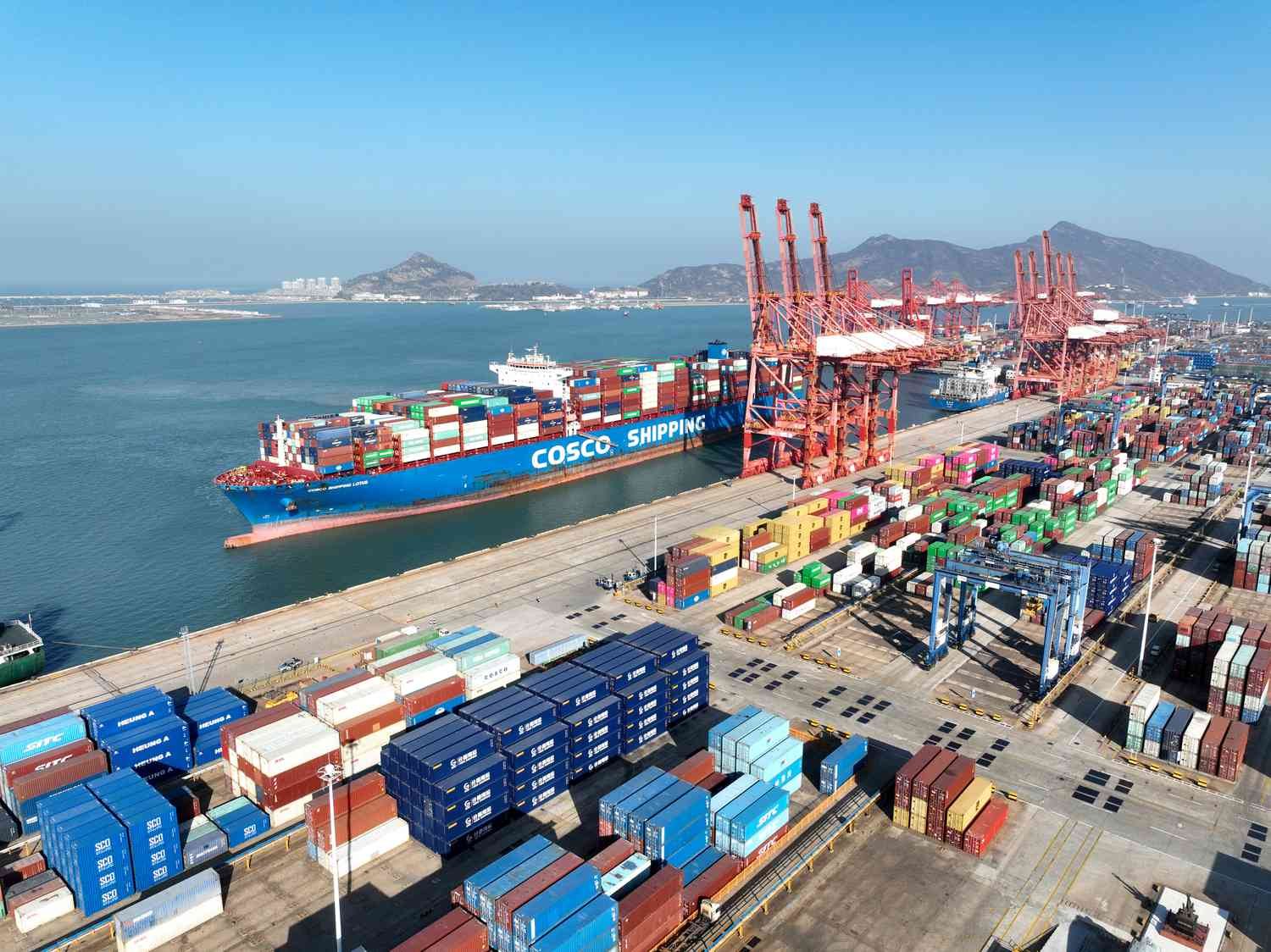
Why the calm windows are the whole game
Ocean freight does not drift. It sits flat for months and then jumps in weeks, and it jumps for reasons that have nothing to do with flooring: a shipping lane made unsafe, a canal running short of water, a tariff deadline that pulls a quarter of demand forward into a single month, a peak season that starts early and refuses to end.
Spring 2026 was one of those flat stretches. Demand was seasonally soft, carriers had capacity to spare, and even active geopolitical tension in the Gulf failed to move the container market much — carriers announced surcharges and could not make them stick. Rates sat in the high three thousands per container to the East Coast.
By August, three things had converged: an early peak season that never tapered, importers front-loading cargo ahead of tariff deadlines, and a Section 122 surcharge expiring on July 24 that put Section 301 duties straight back into effect. Rates more than doubled.
Here is the part that matters for your pricing. The supplier who bought in April is selling April’s freight. The supplier who buys in September is selling September’s freight. Same product, same mill, same container — two prices that can differ by fifteen percent, decided months before either of them quoted you.
Two ways to run a flooring supply business
There are really only two models, and the difference shows up in your invoice.
| Order-driven (just-in-time) | Position-driven (deep inventory) |
| Buys after the customer commits | Buys when the market is calm, holds the position |
| Pays whatever freight costs that week | Pays the freight of the window it bought in |
| Low carrying cost, low risk | Real carrying cost, real risk |
| Lead times follow the ocean: 6–12 weeks | Material is on the floor: same-day pickup |
| Lot consistency depends on what ships | Full lots held together, matched across a job |
| Prices re-quote as the market moves | Prices hold while the lot lasts |
The order-driven model is cheaper to run. Nobody’s capital is sitting in a warehouse in Orlando. But every cost shock in the supply chain passes straight through to the buyer, in full, immediately — because there is nothing in between to absorb it.
Rios Floor runs the second model, deliberately. We buy by market window rather than by order urgency, and we carry the inventory to make that possible. It ties up capital and it means we are wrong sometimes. When we are right — as we were about the spring window — our customers get the benefit rather than a re-quote letter.
What deep inventory buys you besides a lower price
Price is the headline, but contractors who have been burned once tend to care more about the other three.
- Lot consistency across a job. SPC and porcelain are produced in lots, and shade varies between them. When a supplier holds full lots, your 200-unit building gets one lot from unit 1 to unit 200. When a supplier orders as needed, unit 140 arrives from a different production run and the shade shift is visible under the same lighting.
- Schedule certainty. Material sitting in Orlando is available the day you need it. Material still on the water is a promise, and promises are subject to port congestion, customs holds and rollovers.
- Reorders that actually match. Jobs run long, scope changes, someone damages a room. If the original lot is still on the rack, the repair is invisible.
- No minimums. A supplier who already owns the material can sell you two pallets. A supplier who has to order it needs your job to justify a container.
If you are evaluating suppliers on more than price, our 7-point buyer checklist for wholesale flooring suppliers covers the questions worth asking before you commit a project.
Where we buy, and why it is not China
Origin is a risk decision as much as a price decision. Rios Floor imports from India and Southeast Asia rather than concentrating on a single country of origin.
That choice looks better every year. Chinese-made LVT carries Section 301 duties that have been imposed, excluded, reinstated and re-priced repeatedly since 2018 — a policy line item that no importer can forecast and no contractor should have to absorb. Indian porcelain came through its own trade case in better shape: in April 2025 the Commerce Department’s final antidumping determination on ceramic tile from India was negative, terminating that investigation, leaving only a countervailing duty in the low single digits.
Spreading origin across more than one country does not make tariffs go away. It means a single policy decision cannot take our entire catalog off the table — and it means we are rarely forced to buy at a bad moment because the alternative is having nothing to sell.
How to protect your own pricing
You cannot control ocean freight. You can control how exposed your bids are to it.
- Ask when the material was landed, not just what it costs. “Is this in your warehouse today, or is it on order?” is the single most useful question you can ask a flooring supplier. The answer tells you which freight market you are buying.
- Get the lot number in writing on the quote. A price without a lot is a price without a guarantee of match.
- Buy the whole job at once, plus 10%. Overage is cheaper than a second lot, and far cheaper than a shade complaint on a finished unit.
- Put an expiration on material pricing in your own bids. If your supplier’s quote is good for 15 days, your bid should not be good for 60.
- For multi-phase projects, ask the supplier to hold the lot. A supplier with inventory can do this. A supplier without it cannot, whatever they tell you.
- Watch the freight indexes, not the news. The Freightos Baltic Index is public and updates weekly. When the transpacific lines start climbing, you have roughly a quarter before it reaches your invoice.
Where our pricing stands right now
We are holding September pricing on in-stock SPC vinyl lots in Orlando until those lots run out. That covers 9″×60″ and 7″×48″ formats from 12 to 28 mil, along with our large-format porcelain, all of it physically in the warehouse at 3320 Vineland Rd. Trade pricing is for contractors, builders and installers; homeowners are welcome at retail pricing.
When these lots are gone, they will be replaced at whatever the market costs then. That is not a scarcity tactic, it is just how the arithmetic works.
If you are trying to close a client on a color, our Floor Visualizer puts any of these products into a photo of the actual job in about twenty seconds. It is free for trade customers and access is by account — you can request one on that page.
Frequently asked questions
Why did flooring prices go up in 2026?
Primarily ocean freight. Asia to US East Coast container rates rose from about $3,810 per forty-foot container in April 2026 to $9,144 in August 2026 — roughly 140% — driven by an early peak season, importers front-loading cargo ahead of tariff deadlines, and the expiration of the Section 122 surcharge on July 24 that returned Section 301 duties to effect. Mill prices moved far less.
How much does freight add to the cost of vinyl flooring per square foot?
A 40-foot high-cube container holds roughly 29,000 square feet of 5 mm SPC before hitting its weight limit. Spreading the 2026 freight increase of about $5,334 per container across that volume works out to roughly 18 cents per square foot. Thicker planks weigh more per square meter, fit less in a container, and carry a higher freight cost per square foot.
Why is buying flooring in bulk cheaper?
Volume discounts are a small part of it. The larger effect is timing: buying full containers during a calm freight market locks in that market’s cost for the life of the inventory. A supplier holding material bought at $3,800 freight can sell against a competitor buying at $9,100 freight, on identical product from the same mill.
Should I buy flooring now or wait for prices to come down?
If you are buying from in-stock inventory that was landed before the increase, buying now captures the older freight cost. If you are ordering material that still has to ship, you are exposed to the current market. The question to ask is not when to buy, but which inventory you are buying from.
How do I know if a supplier actually has the material in stock?
Ask to see it. A supplier with real inventory can tell you the lot number, the quantity on hand and the pickup date on the phone, and will let you walk the warehouse. A supplier drop-shipping from a container will give you a lead time instead of an answer.
Rios Floor is a direct-import wholesale flooring supplier in Orlando serving contractors, builders and investors. In-stock SPC vinyl plank and large-format porcelain tile, full lots held for matching, no contractor minimums, ready for pickup at 3320 Vineland Rd, Suite A.
Request a trade quote · Download the 2026 catalog · Visit the showroom · (321) 200-3295
Freight rate figures cited from Freightos Baltic Index reporting for April 21 and August 11, 2026. Trade case status from the U.S. Department of Commerce final determinations on ceramic tile from India, April 2025. Container capacity figures are approximate and vary by plank thickness, format and packing. Duty treatment depends on classification and entry date and should be confirmed with a licensed customs broker.